-
INVICTA Group Services
chevron_left Backclose
INVICTA Group Services
- INVICTA Group
- INVICTA Clinics
- Medical Laboratories
- Fertility Bank
-
Anti-Aging Clinic
- R&D Centre
- NAMI
Fact checked by: Patrycja Drężek
Update date: 27 July 2026
Publish date: 26 May 2025
Read in: 9 min
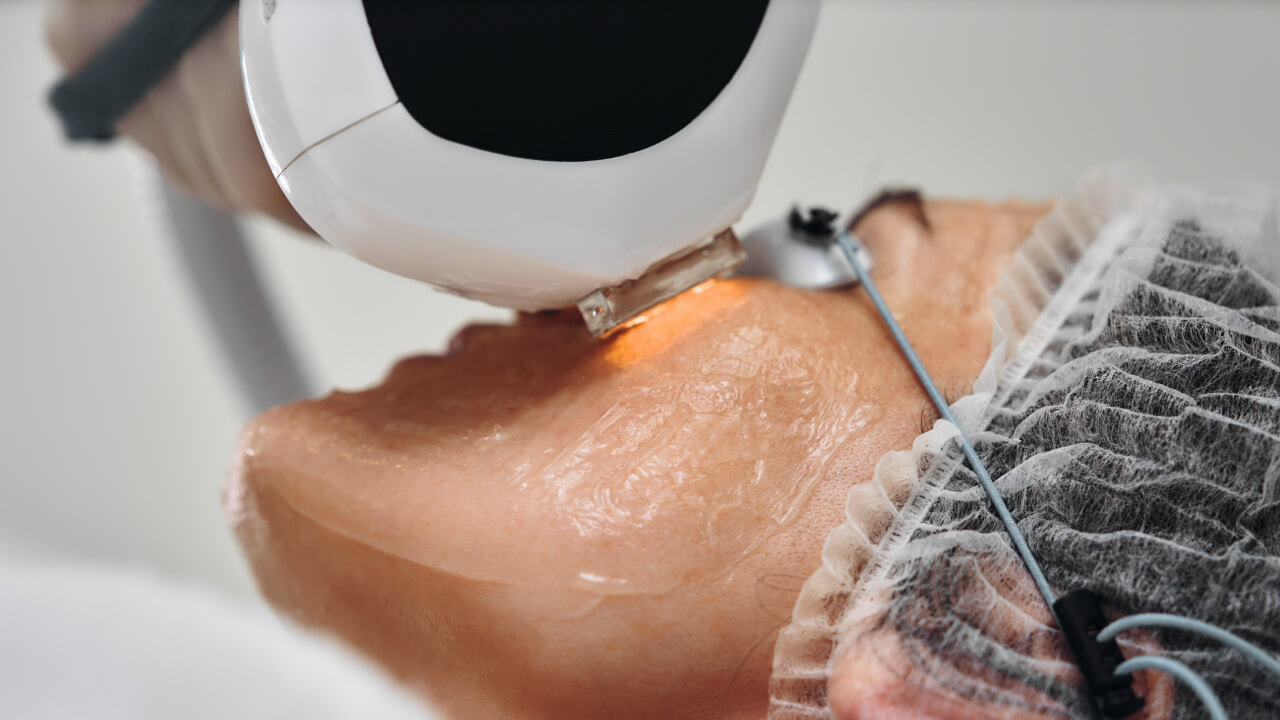
Facial laser treatments are one of the most effective ways to address a range of aesthetic skin concerns. Unwanted hair, pigmentation, redness, acne scars, or broken capillaries can be reduced thanks to lasers that use different technologies. These are safe, minimally invasive solutions designed for various skin types and concerns.
Table of Contents
The skin contains tissue-building substances known as photoacceptors (chromophores), including water, melanin, and hemoglobin. Different types of facial lasers emit a beam of light at a specific wavelength that targets a particular chromophore. For example, when treating broken capillaries with laser therapy, the laser head is designed to act on hemoglobin, while melanin absorbs the laser beam used for laser hair removal.
Many laser treatments—on the face and beyond—use the principle of selective photothermolysis. This involves controlled, thermal damage to skin tissue in precisely selected areas. The tissue is intentionally and carefully damaged, then regenerates. This rebuilding process is associated with increased synthesis of collagen and elastin—proteins essential for youthful, firm, and resilient-looking skin. This approach also helps minimize potential unwanted side effects of the procedure.
Laser therapy is widely used in many areas of medicine, including ophthalmology, orthopedics, and dermatology. In cosmetology and aesthetic medicine, lasers are one of the most effective ways to treat many conditions and aesthetic skin concerns.
Common uses of facial laser treatments include:
removing unwanted hair,
supporting acne treatment,
reducing wrinkles,
scar therapy, including acne scars,
photorejuvenation and facial lifting,
removing tattoos and permanent makeup.
Facial laser treatment is a safe option for photorejuvenation and for treating conditions or aesthetic concerns visible on the skin—as long as it is properly selected for the specific issue and your skin phototype (a skin classification based on how it reacts to UV radiation).
The procedure should be performed by a qualified specialist, and patient safety also depends on following recovery guidelines strictly.
In some situations, laser therapy may not be possible and should be postponed. Contraindications include, among others:
pregnancy,
active skin infections in the treatment area,
an active or recently treated cancer,
a tendency to develop keloid scars and other healing disorders,
uncontrolled diabetes.
Immediately after a facial laser procedure, the skin is usually slightly irritated. To help it regenerate quickly and effectively, it’s important to support it with proper aftercare.
The specialist who performed the treatment will explain how to care for your skin during recovery and after it ends—follow their instructions closely. When giving recommendations, they will take into account, among other things, the type of procedure performed and the patient’s individual skin condition. Typically, aftercare guidelines include using soothing creams and ointments, cooling the treated areas, and applying products with high sun protection.
Among the lasers most commonly used in cosmetology and aesthetic medicine are fractional lasers and diode lasers, as well as various types of IPL devices (Intense Pulsed Light). You may also come across terms such as thulium laser, fractional CO₂ laser, ablative fractional laser, picosecond laser, CPL, and Nd:YAG. These names relate, for example, to the laser wavelength, the effect it produces, or the way it works.
An experienced cosmetologist or physician will select the right type of laser, technology, wavelength, and other treatment parameters based on the patient’s needs and the condition of their skin.
Below, we present some of the most popular laser treatments for the face and beyond—designed to address specific patient needs and deliver high effectiveness.
Hyperpigmentation and dark spots can develop for different reasons. However, regardless of the underlying cause, they often lead to discomfort and even self-consciousness. Laser pigmentation removal makes it possible to effectively get rid of small dark spots located on any area of the face or body. The procedure is precise and non-invasive. Thermal micro-injuries within the pigmented area may cause the spots to darken temporarily, and after a few weeks this leads to peeling of the discolored layers of the epidermis. The full result is usually visible after 30 days.
Many people dream of permanently getting rid of unwanted hair—not only on the face, but also on other parts of the body. Laser hair removal can be the solution. The first results are often visible after 1–2 treatments, and the number of regrowing hairs decreases gradually with each session. The only possible side effect may be slight skin redness, which fades after a few hours. Laser hair removal is especially valued by people with dark hair, for whom it’s even harder to deal with the so-called “black dots” effect—short, stubbly regrowth after a few days that tends to be resistant to at-home methods.
Laser removal of skin lesions is an effective way to eliminate often unsightly growths that can appear not only on the face but also anywhere on the body. The procedure can help remove, among others, moles, fibromas, lesions of viral origin, warts, and genital warts. It does not require hospitalization, and lesions are removed with exceptional precision, which minimizes the risk of scarring. In this case, laser therapy is painless (the doctor administers injectable anesthesia), and full healing of the treated area—depending on the type of lesion removed—usually takes up to 4 weeks.
Laser treatment for broken capillaries is a popular method for reducing vascular lesions, or telangiectasia (so-called spider veins). With a properly selected laser beam, these vessels become no longer visible. The procedure targets vessels located close to the surface of the skin, which means that when there is a dense cluster of capillaries in a small area, minor bruising may occur—however, it will fade after a few days. The treatment is non-invasive, safe, and does not require a long recovery period.
Any laser treatment—whether for the face or other parts of the body—is best performed between autumn and spring. This is the time of year when UV radiation is at its lowest, and the skin treated with laser therapy needs protection from UV exposure. Lower temperatures also support recovery, helping to avoid uncomfortable irritation.
During the autumn and winter months, unwanted effects of summer sunbathing often become more visible as well—such as hyperpigmentation and dark spots. The sooner you treat them with laser therapy, the better your chances of removing them completely.
Wondering what a facial laser can do? Results depend, among other things, on the technology used and the type of laser, the number of sessions completed, and the patient’s specific concerns. In general, after facial laser treatment you can often expect, among others:
a more even skin tone,
reduced sun spots and post-inflammatory hyperpigmentation,
reduced redness and so-called spider veins,
reduced scars and acne marks,
smoother wrinkles,
improved skin firmness and tightness,
reduced hair growth.
In some cases, the results of facial laser treatments are visible almost immediately, while in others it may take a few weeks and several treatment series.


Read more