-
INVICTA Group Services
chevron_left Backclose
INVICTA Group Services
- INVICTA Group
- INVICTA Clinics
- Medical Laboratories
- Fertility Bank
-
Anti-Aging Clinic
- R&D Centre
- NAMI
Fact checked by: lek. Michał Bartos
Update date: 24 July 2026
Publish date: 27 June 2025
Read in: 7 min
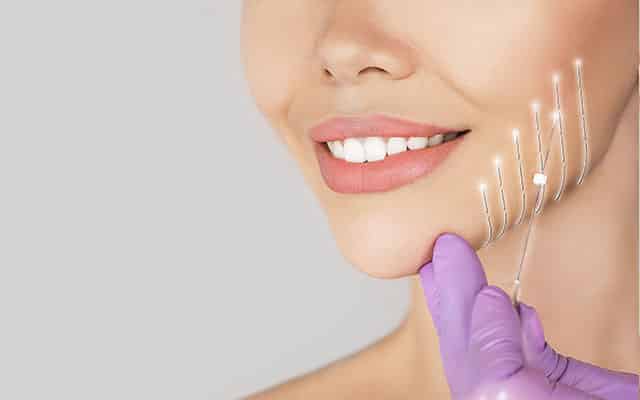
Almost everyone dreams of maintaining a healthy and youthful appearance for as long as possible. Unfortunately, over time, wrinkles become more visible, and the skin loses its firmness. The shape of the face also changes, with sagging cheeks and a protruding jawline. While the aging process cannot be stopped, aesthetic medicine clinics offer safe, non-surgical treatments that can help slow it down. One of the most popular and effective solutions for rejuvenating and correcting skin imperfections is PDO threads.
As we age, the skin becomes looser and loses its firmness. However, advancements in modern technology now allow us to maintain a youthful and beautiful appearance for longer. Aesthetic medicine offers numerous solutions, one of which is PDO threads made from polydioxanone. These threads are a less invasive alternative to traditional facelifts. They were first used 20 years ago in complex surgical procedures, such as in ophthalmic microsurgery, urology, and gynecology. Thanks to their absorbable nature and ability to stimulate fibroblasts and collagen production, PDO threads have now found their application in aesthetic medicine.
PDO threads are especially effective for individuals looking to combat the effects of aging but who are hesitant about the significant body intervention required in plastic surgery procedures. These ultra-thin threads, inserted under the skin, are primarily used for lifting and improving the facial contour. They also smooth out wrinkles, especially in areas where it is difficult to use fillers or botulinum toxin (such as on the forehead, around the lower eyelid, under the chin, or the neck):
– PDO thread treatments are recommended for patients who do not yet have very deep wrinkles, says Dr. Magdalena Klunder. “At the INVICTA Anti-Aging Clinic, we use 16 different types of threads with varying thickness, length, and applications. The strongest lifting effect is achieved with the threaded threads equipped with hooks, called Lift Strong, which are made using the molding technique. The other threads – slotted threads – provide a more subtle effect. The Smile on thread is used for lifting the corners of the mouth and eyes, while the Brow Up thread is designed for brow lifting. For filling, we use Cavern Fill and Multi-Fill threads. The first ones are arranged in a tight tunnel shape, resembling a spring. We use them to fill hollow cheeks, forehead or eye wrinkles, nasolabial folds, double chin, and “marionette lines.” The latter consists of fourteen threads in one, resembling a delicate fan, and is perfect for filling and lifting sagging tissues in the temple, eye socket, or cheeks. These are the safest threads on the market, providing a delicate and natural effect, with minimal risk of complications,” she adds.
Thin threads made from polydioxanone have an incredibly wide range of applications. They can be used not only to rejuvenate the face by correcting the facial contour, firming the double chin, and lifting sagging cheeks and the corners of the mouth (thus reducing “marionette lines”). PDO threads are also highly effective at lifting drooping eyelids and defining the shape of the eyebrows. The skin where the threads are inserted becomes better hydrated, tightened, and firmer. The best results with PDO threads are typically achieved in individuals aged 30-65.
One of the greatest advantages of PDO threads is their ability to be applied almost anywhere on the body. This includes not only the face but also the skin of the neck, décolletage, breasts, elbows, knees, abdomen, and buttocks. For many people, the fact that the results are very natural is a key benefit. A new trend in aesthetic medicine is the “natural look” effect, which focuses on rejuvenating the skin in a way that makes you look younger without altering your facial features. The pattern in which the threads are inserted under the skin is always customized to meet the specific needs and expectations of each patient. Moreover, due to the use of injectable anesthesia, the procedure is nearly painless. However, it’s best to undergo the treatment during a few days off or on weekends, as it may cause bruising, minor hematomas, or swelling.
During the procedure, performed under local anesthesia, the doctor inserts PDO threads under the patient’s skin. Depending on the area being treated, the application of the threads can take between 30 and 60 minutes. The sterile PDO threads, made of polydioxanone, stimulate the synthesis of collagen and elastin fibers in the tissues. These fibers not only fill in deep wrinkles and folds but also trigger the skin’s self-regeneration mechanisms, improving its tension, elasticity, and firmness.
Moreover, this treatment not only improves the current condition of the skin but also prevents the formation of new wrinkles. The appearance of the skin improves immediately after the threads are applied. However, the best results are seen after 2-3 months, as new collagen starts to form. Regeneration processes continue throughout the period the threads remain in the skin, and the effects are visible even after the threads have completely dissolved.
It’s important that every PDO thread treatment is preceded by a consultation, during which the doctor will discuss achievable results, rule out contraindications, and explain how to prepare for the procedure. Immediately after the treatment, aspirin should not be taken, and alcohol consumption should be avoided. Additionally, for 14 days after the procedure, patients should avoid exercising, sunbathing, and exposing their skin to chemical vapors (such as those from hair dye). A follow-up appointment is also necessary after each PDO thread procedure.


Read more