-
INVICTA Group Services
chevron_left Backclose
INVICTA Group Services
- INVICTA Group
- INVICTA Clinics
- Medical Laboratories
- Fertility Bank
-
Anti-Aging Clinic
- R&D Centre
- NAMI
Fact checked by: lek. Gabriela Tokarska
Update date: 27 July 2026
Publish date: 27 June 2025
Read in: 10 min
Scars can form as a result of surgery, cuts, injuries, illnesses, accidents, burns, or acne. They can become a serious aesthetic and medical concern. Scars may be a source of discomfort, embarrassment, and insecurity, but they can also interfere with daily functioning, causing pain, tenderness, itching, and even sleep disturbances, anxiety, or depression. This is why various methods of scar therapy, reduction, and removal — such as scar mobilization, laser therapy, or scar patches — are so important for many patients.
Table of Contents
Almost everyone has at least one scar on their body, as scars are the result of the natural wound-healing processes that occur after an injury or a surgical procedure. The way this skin change develops and its final appearance largely depend on the degree of damage to the individual layers of the skin and subcutaneous tissue, as well as on whether any disturbances occur during the different stages of wound healing, such as:
hemostasis – the formation of a clot that prevents further blood loss;
the inflammatory phase;
proliferation – the process of cell division and multiplication that supports wound healing;
remodeling – the stage during which the scar tissue becomes lighter, stronger, and more elastic.
The final appearance of a scar is also influenced by factors such as the location of the injury, the type of trauma (burn, cut, incision, crush injury), age, genetics, sex, ethnic background, and an individual tendency to develop scars.
During scar formation, the damaged tissue or skin is replaced by new tissue rich in collagen fibers. At first, these fibers are arranged randomly and only later become more organized. Unfortunately, the structure and color of scar tissue differ from healthy skin. The superficial layers of scar tissue are thin and lack sweat glands, sebaceous glands, hair, and melanin-producing cells, which is why most scars are lighter than the surrounding skin.
Scars are most commonly classified according to their origin, time of formation, and appearance. The first group includes postoperative scars, burn scars, and scars after a cesarean section.
The second group consists of immature scars (they are red and slightly raised and may cause a feeling of skin tightness, itching, or even pain) and mature scars, which in a normal healing process become lighter in color and soft to the touch.
When classified according to their appearance, the following types are distinguished:
Hypertrophic scars – these most often develop as a result of a prolonged wound-healing process, which may be caused by improper wound care (e.g., lack of appropriate dressing or infection). These scars are thickened and red but remain within the boundaries of the original wound.
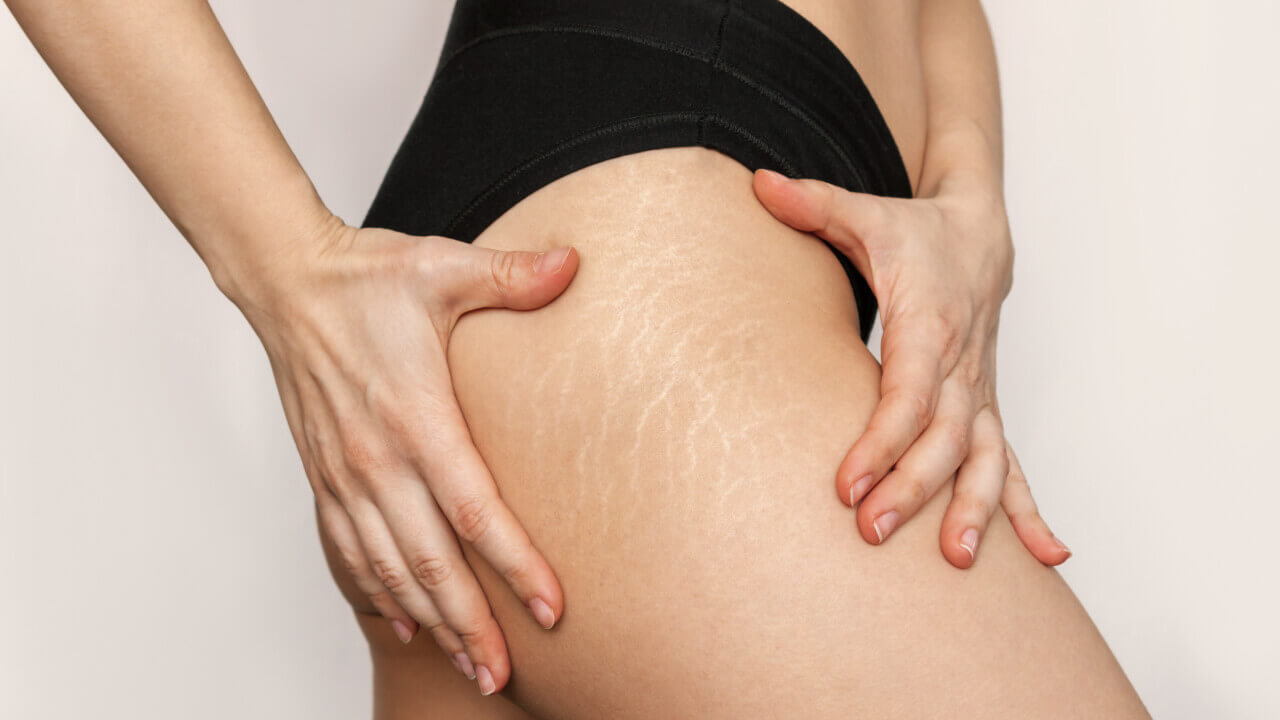
Atrophic scars – these mainly develop when the wound-healing process is disrupted due to insufficient production of connective tissue fibers, for example during acne or chickenpox. They appear as depressions in the skin and become more visible with age. They may vary in depth and shape but are most often round. Atrophic scars also include stretch marks.
Keloid scars (keloids) – their formation is associated with excessive collagen production that occurs after skin injury. Unlike hypertrophic scars, they always extend beyond the original wound margins and enlarge over time (they also do not tend to flatten or regress spontaneously). Keloids usually have an irregular shape and a purple or red color. They can develop at different ages, but most often occur in people with darker skin tones between the ages of 10 and 30.
Scar contractures – these are scars located in areas of skin folds that develop as a result of the contraction of connective tissue (especially in later stages of burn scar formation). These scars are deep and can tighten the skin, limiting mobility. Scar contractures require surgical treatment.
It is important to remember and be prepared for the fact that the process of removing a scar can sometimes be complex and long-term. In some cases, the best results are achieved by combining different methods. Sometimes it is also necessary to accept that not every scar can be completely removed, and that treatment may only make it less visible.
Patients have various options for scar treatment. Their effectiveness depends, among other things, on the type of scar tissue, its size, and the location where it developed. The timing of treatment is also important — the earlier therapy begins, the better the potential results.
A specialist (cosmetologist, dermatologist, or surgeon) will choose the appropriate method for reducing the scar. Its appearance can be improved through surgical techniques, cosmetology treatments, or laser therapy.
Conservative methods are also used in scar therapy, mainly to prevent abnormal scarring. Proper care using special ointments, gels, creams, or silicone scar patches for fresh scars helps prevent the formation of hypertrophic scars and keloids. Fresh scars can also easily become discolored when exposed to UV radiation. To prevent this, it is advisable to use high sun protection.
A scar does not affect only appearance — it may also influence tissue function, for example by limiting mobility.
Various laser therapy and cosmetology treatments can be an effective part of scar therapy. Below we present several methods that help reduce scars on the face and body, including acne scars, postoperative scars, post-traumatic scars, and burn scars.
Laser scar removal using a medical fractional CO₂ laser is one of the most effective and least invasive methods of reducing scar tissue. Fractional technology is a modern, non-surgical solution that allows the treatment of both mature and fresh scars of various origins (such as stretch marks and scars: post-acne, post-surgical, post-traumatic, or burn scars).
As a result of ablation, which involves the controlled removal of scar tissue, the damaged tissue is replaced with regenerated and healthy tissue. The procedure is performed after prior local anesthesia of the skin and does not require a long recovery period (usually 7–28 days).
The first effects are visible once the skin has healed. However, depending on the type of scar, several treatments may be necessary. Initially, they reduce the visibility of the scar and later can almost completely eliminate the trace of the wound.
Additionally, the laser has a rejuvenating effect on the skin, making it firmer and giving it a fresh appearance. It smooths both fine and deep wrinkles, improves the condition and firmness of lax skin, and enhances skin tone by removing certain types of discoloration (see: How to get rid of discoloration on the face?).
Microneedling mesotherapy is a very effective method for reducing various types of scars — including acne scars, post-traumatic scars, and stretch marks. It is an effective and safe skin microneedling procedure that uses patented pulsating needle technology. The micro-injuries created during the treatment stimulate skin regeneration (they activate the skin’s natural repair and healing mechanisms), which gradually reduces the appearance of scars.
To achieve satisfactory results, the procedure should be repeated after about 4 weeks and performed at least three times. After the treatment, patients can return to their daily activities.
Microneedle radiofrequency is a treatment that delivers excellent results in scar reduction. It combines the technique of skin microneedling with radiofrequency energy that penetrates deeper skin layers. Microscopic needles penetrate the skin to a controlled depth, delivering radiofrequency waves and nourishing substances into the tissues.
Good results can also be achieved by injecting scars with tropocollagen or platelet-rich plasma. Tropocollagen is the basic building block of collagen fibers responsible for the skin’s elasticity and firmness. Platelet-rich plasma, on the other hand, is a natural preparation obtained from the patient’s own blood.
Both substances stimulate the body’s regenerative processes. As a result of treatments using these substances, the skin regains a healthier appearance and scars become much less noticeable.
Effective scar therapy may also involve combining different treatment methods. Possible combinations include laser scar removal with tropocollagen or platelet-rich plasma injections, microneedle radiofrequency with injections, or microneedling mesotherapy combined with injectable treatments.


Read more